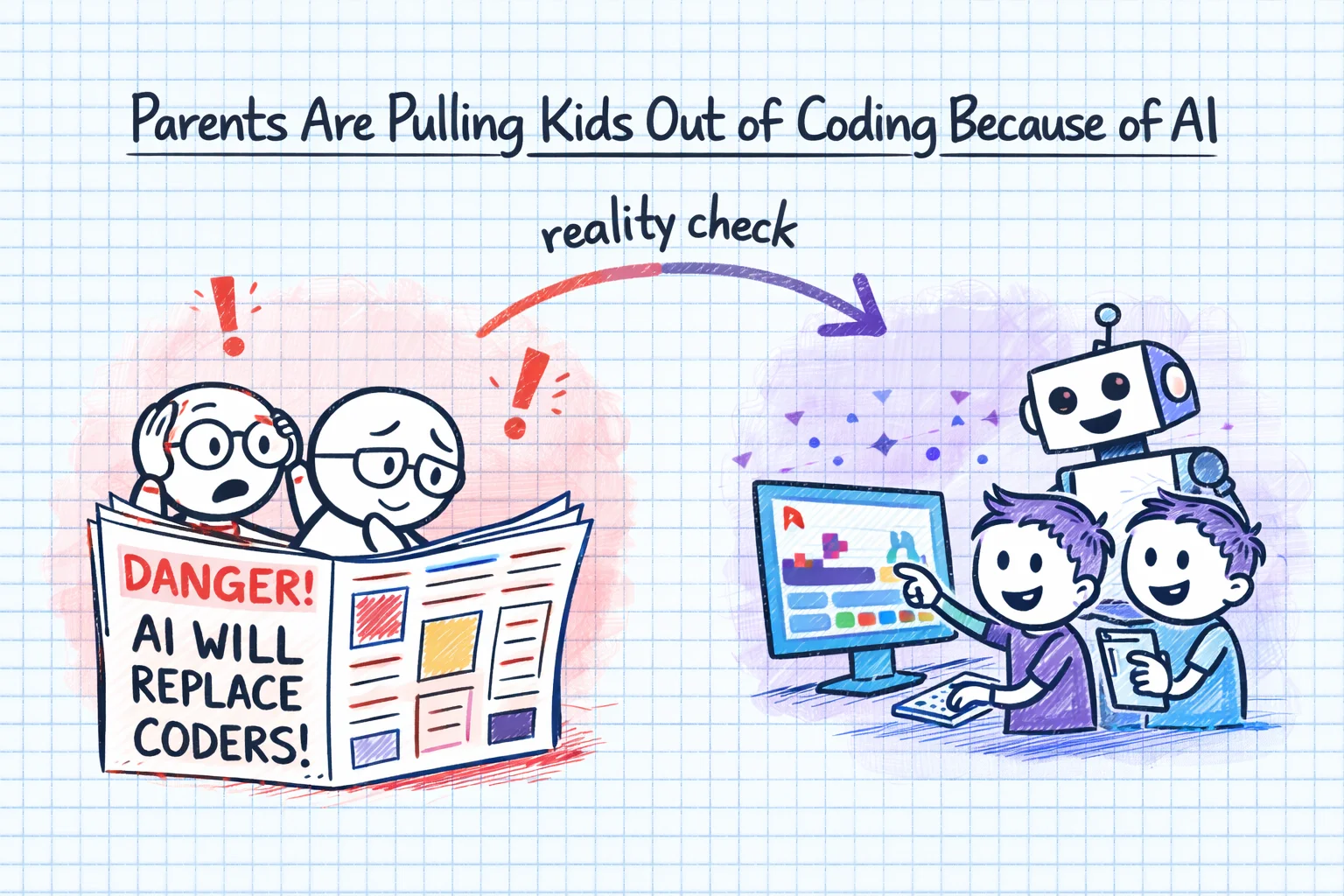
In February 2025, the Telegraph ran a headline: "Fears of AI bloodbath for tech jobs prompts calls to scrap coding push." The numbers were stark. UK software developer vacancies had dropped from 125,908 in January 2020 to 82,629 by January 2025. Jensen Huang was saying coding is no longer essential. Zuckerberg was claiming AI would match mid-level engineers.
I read it, thought "well, that's going to cause us problems", and got on with my day.
Ten months later, it caused us problems.
The Phone Call We Couldn't Make
In December 2025, we lost a student. Not because they didn't enjoy the classes, not because of scheduling, and not because of cost. A parent pulled their child out of The Code Zone because they believed - based on articles exactly like that Telegraph piece - that coding jobs won't exist by the time their kid enters the workforce.
We tried to arrange a call to talk it through. We sent over some of our thinking on the subject, including an earlier version of this blog. We couldn't get hold of them. They'd already made up their minds.
And here's what frustrates me about this: I don't just teach kids to code. I write software for a living. I'm CTO of a SaaS company serving millions of users. I've been building software for fifteen years. And for months now, I've used AI every single day as part of my development workflow.
I am not an observer of this shift. I am living it. And the conclusion I've reached is the exact opposite of what that parent believed.
What AI Actually Does to a Developer's Day
Let me describe my actual working day, because the headline version of AI and the reality are so far apart it's almost funny.
I use Claude Code - an AI coding assistant - as a constant companion. It helps me write Azure DevOps pipelines, debug Blazor components, scaffold new features, analyse Application Insights exceptions, and a dozen other things. It makes me significantly faster at my job.
Here's what it doesn't do: think for me.
When I ask it to build a deployment pipeline, I need to understand what a deployment pipeline is, why it's structured the way it is, and how to evaluate whether what the AI produces is actually correct. When it generates code, I need the architectural knowledge to know whether that code belongs in a service, a controller, or a middleware component. When it suggests a fix for a bug, I need the domain expertise to know whether the fix makes sense in the context of our business logic.
The AI is a power tool. It's not the craftsperson. And nobody looks at a carpenter using a nail gun and says "well, I suppose there's no point learning carpentry now."
The Skills That Actually Matter
The Telegraph article focused on a specific definition of "coding" - writing lines of syntax in a programming language. And yes, the proportion of a developer's job that involves manually typing out boilerplate code is shrinking. That part is true.
But that was always the least interesting part of the job. It's like saying "calculators have made arithmetic obsolete, so there's no point studying maths." The syntax was never the point. The thinking was the point.
What we teach kids at The Code Zone isn't really "coding" in the way that headline means it. We teach:
Logical thinking. Breaking a big problem into smaller problems. Understanding cause and effect. Sequencing. Conditionals. Loops. These aren't programming concepts - they're thinking concepts. Programming just happens to be an extraordinarily effective way to teach them.
Debugging. Something doesn't work. Why? Where do you start looking? How do you isolate the problem? This is the single most transferable skill in computing, and AI hasn't made it less important - if anything, it's made it more important. You now need to debug what the AI produces as well as what you write yourself.
Creative problem-solving. There are twenty ways to make a character jump in Scratch. Which one feels right? Which one is efficient? Which one can you extend later when you want to add double-jumps? These are design decisions, and AI can't make them for you because they depend on what you're trying to create.
Computational thinking. Understanding how computers process information. Not the syntax of a for loop, but the concept of iteration. Not the specific API for a database query, but the idea of storing and retrieving structured data. These fundamentals don't change when the tools change.
The Jobs Aren't Disappearing. They're Changing.
Those vacancy numbers in the Telegraph article are real, but they don't mean what the headline implies. The UK tech sector went through a significant correction after the post-COVID hiring boom. Companies that hired aggressively in 2021-2022 pulled back in 2023-2024. Interest rates rose, funding dried up, and hiring slowed across the entire economy, not just tech.
At the same time, the nature of the roles is shifting. There's less demand for developers who can only write basic CRUD applications, because yes, AI can do a lot of that now. But there's growing demand for developers who can architect systems, evaluate AI output, integrate AI into products, and solve the complex problems that AI can't handle alone.
The developers who are thriving right now aren't the ones ignoring AI. They're the ones using it to multiply their output while applying the judgement and expertise that comes from actually understanding how software works.
What Happens If You Don't Teach Kids to Code
Here's the scenario that genuinely worries me. A generation of kids grows up being told "AI will do the coding", so they never learn how any of it works. They become consumers of AI-generated software without any ability to evaluate, modify, or understand it.
That's not empowerment. That's dependency.
When a child learns to code - even at the basic level of making a sprite move across the screen in Scratch - they're learning that computers do what you tell them. That the magic is actually logic. That they can create things, not just use things other people created. That understanding is power.
Taking that away because "AI will handle it" is like not teaching kids to write because speech-to-text exists. The tool doesn't replace the understanding. It builds on it.
What I'd Say to That Parent
If I could have that phone call, here's what I'd say:
Your child isn't learning to code because they need to memorise Python syntax. They're learning to code because it teaches them how to think systematically, solve problems creatively, and build things from scratch. Those skills are more valuable in an AI-powered world, not less.
The kids who will thrive in ten years aren't the ones who avoided technology. They're the ones who understood it deeply enough to work with it, direct it, and know when it's wrong.
I use AI every day. It makes me better at my job. But it only works because I spent fifteen years learning how software actually works. Your child is at the start of that journey, and the last thing you should do is cut it short because a newspaper headline scared you.
The future doesn't belong to people who can code. It doesn't belong to AI. It belongs to people who can think clearly and use every tool available to them - including AI - to build things that matter.
That's what we're teaching. And it's never been more relevant.