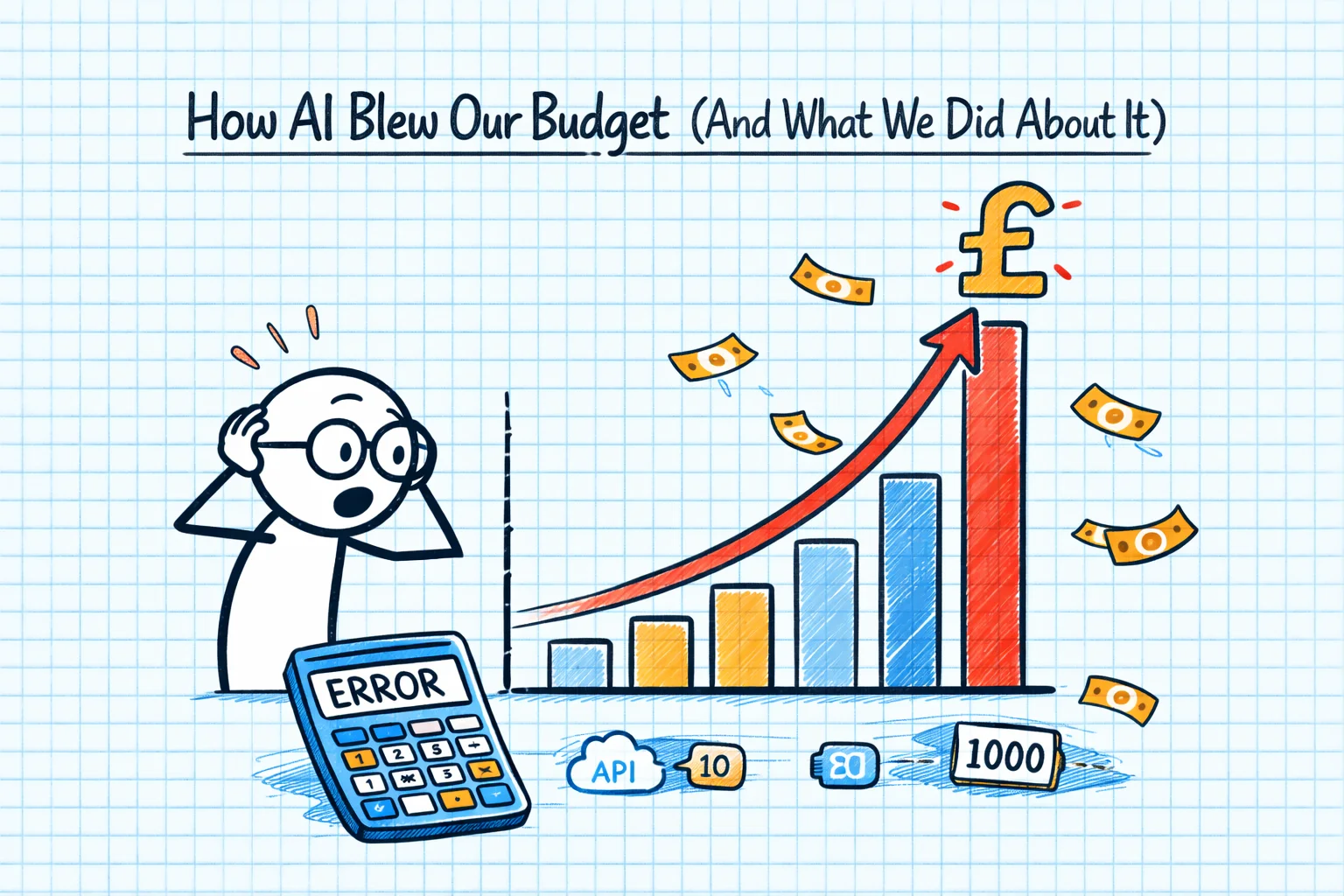
There's a narrative in the AI world that goes something like this: AI is cheap, getting cheaper, and will soon be essentially free. OpenAI offers a free tier. Claude has a free tier. You can build an AI-powered anything for pennies.
This narrative is, at best, incomplete. At worst, it's dangerously misleading for anyone trying to integrate AI into an actual business.
I know this because we blew through our AI budget in a way that nobody saw coming, and the lessons we learned are the kind of thing I wish someone had written about before we had to discover it ourselves.
The Promise vs The Bill
When we started integrating AI into our operations at The Code Zone, the cost projections looked manageable. API pricing seemed reasonable. A few pence per interaction. Manageable token counts. We did the maths, it added up, and we proceeded with confidence.
Then the bill arrived.
The numbers were eye-watering. Not because any single API call was expensive, but because of volume. When you integrate AI across multiple systems - customer support, content generation, code assistance, data analysis - the interactions multiply. And each interaction consumes tokens. And tokens cost money.
The problem wasn't the per-unit cost. It was that we'd massively underestimated the number of units.
Where the Money Actually Goes
Here's what caught us off guard, and what I suspect will catch other businesses off guard too:
Context is expensive. Every time you give an AI model context - background information, conversation history, system prompts - you're paying for those tokens. And for useful AI interactions, you need a lot of context. Our system prompts alone, the instructions that tell the AI how to behave, were consuming a significant chunk of tokens before the user even asked a question.
Iteration multiplies costs. In development, I might have a back-and-forth with Claude that goes five or six rounds to solve a problem. Each round sends the entire conversation history plus new content. By round six, you're paying for a lot of repeated tokens. Multiply that by a team of developers doing this all day, and the numbers add up fast.
The wrong model for the job is expensive. Early on, we were using our most capable model for everything - simple queries, complex analysis, basic formatting tasks. That's like taking a taxi to the corner shop. It works, but you're dramatically overpaying.
Failed experiments still cost money. When you're exploring what AI can do, you try things that don't work. Those failed experiments consumed tokens too. Research and development has always cost money, but with AI the cost is per-attempt rather than a fixed salary, which means it scales with your ambition.
The Forecast That Made Us Nervous
At one point, when we projected our AI costs forward based on current usage patterns, the numbers were genuinely alarming. We were looking at a trajectory that would have made AI our second-largest operational cost after salaries.
That's not sustainable for any business, and it's certainly not sustainable for a small edtech company. Something had to change.
What We Actually Did
The solution wasn't "use less AI". That would be like solving a high electricity bill by turning off the lights - technically effective, but you can't see what you're doing anymore. Instead, we got methodical about it.
Model routing. Not every task needs your most powerful model. Simple classification, basic text formatting, straightforward Q&A - these can be handled by smaller, faster, cheaper models. We implemented a tiered approach: simple tasks go to lightweight models, complex reasoning goes to the full model. This alone cut costs dramatically.
Prompt caching. If you're sending the same system prompt with every request - and most applications do - you're paying for the same tokens over and over. Prompt caching lets you pay once and reuse. The savings can be substantial - we saw cost reductions of up to 90% on cached prompts.
Batch processing. Not everything needs real-time responses. Reports, analysis, content generation - these can be batched and processed during off-peak hours at reduced rates. Some API providers offer significant discounts for batch processing, sometimes 50% or more.
Token budgets. We set explicit token budgets per feature, per user, per day. This forced us to think about efficiency in a way we hadn't before. How can we get the same quality output with fewer input tokens? How can we structure our prompts to minimise context while maintaining accuracy?
Considering local models. For certain tasks, we explored running models locally rather than using cloud APIs. Open-source models on platforms like Hugging Face have improved dramatically. The trade-off is capability versus cost - local models are less powerful but essentially free per interaction once you've invested in the hardware. For high-volume, lower-complexity tasks, the economics can make sense.
What I Wish Someone Had Told Us
If you're planning to integrate AI into your business, here's the pricing reality check I wish we'd had:
Do the maths at scale, not at prototype. A proof of concept with ten users costs almost nothing. The same system with a thousand users costs a hundred times more. This seems obvious, but the "it's only a few pence per interaction" framing makes it easy to forget.
Budget for experimentation separately. Your R&D usage patterns will be wildly different from your production usage patterns. Track them separately. Don't let development costs contaminate your production cost projections.
Monitor from day one. We didn't have granular cost monitoring in place early enough. By the time we realised costs were escalating, we'd already accumulated a significant bill. Set up dashboards, alerts, and per-feature cost tracking before you go live, not after.
The cheapest token is the one you don't send. Every piece of context you include in a prompt should earn its place. Audit your system prompts regularly. Are you sending information the model doesn't need for this specific task? Cut it. Those savings compound across every single interaction.
The Honest Summary
AI is not cheap. It's not expensive either. It's variable, and the variation between "managed well" and "managed poorly" can be the difference between a minor operational cost and a budget-threatening liability.
We went through the expensive learning curve so you don't have to. The technology is worth it - the productivity gains from AI integration are real and significant. But go in with your eyes open, your monitoring in place, and your model routing planned before you scale.
Nobody writes about this part. The AI hype cycle is all about capability. But for businesses actually implementing this stuff, cost management is just as important as capability. And the sooner you treat it that way, the better off you'll be.