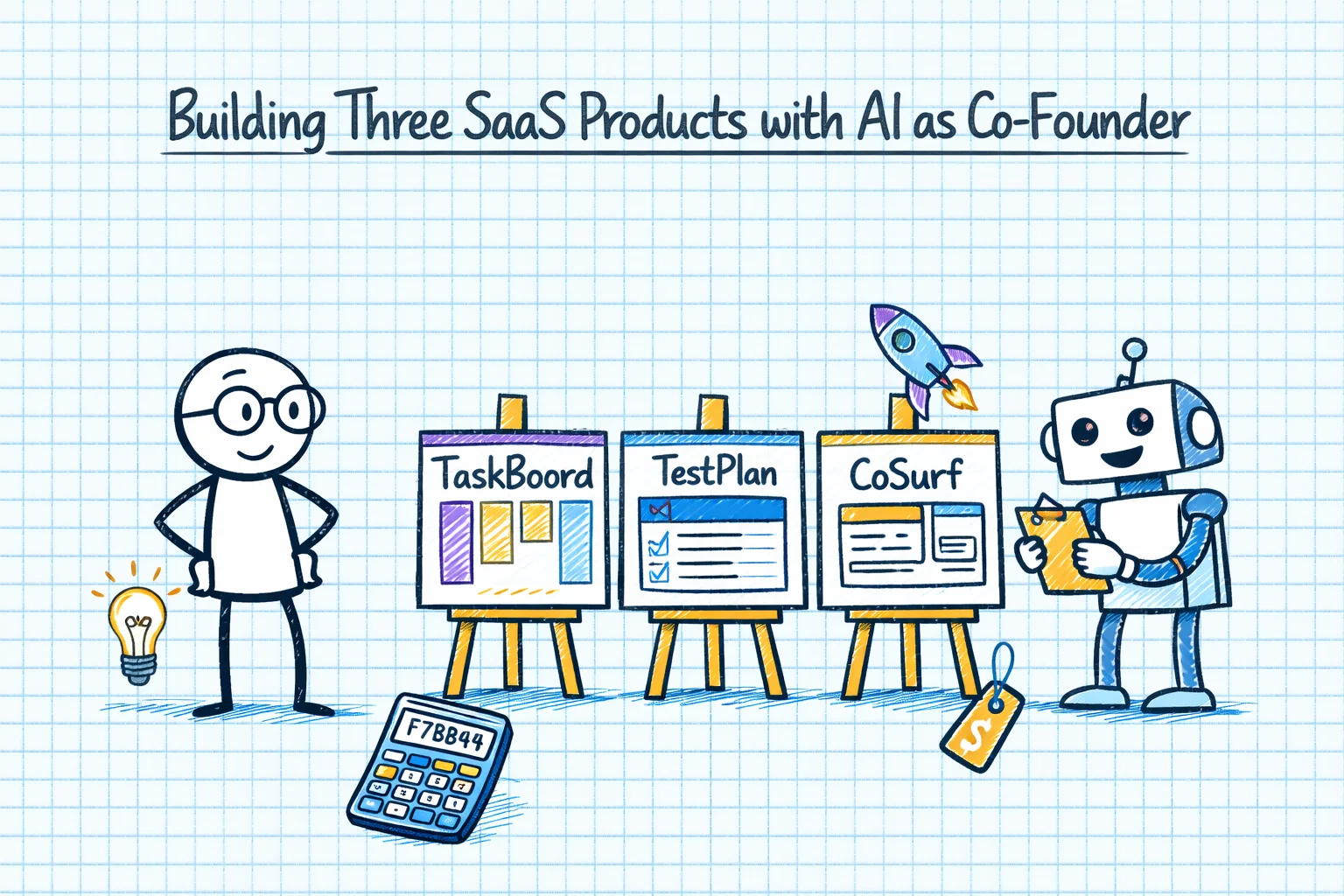
Alongside the day job, I found myself doing what I always do when I have mental space: building things. Specifically, three SaaS products - CoSurf (co-browsing), Task Board (project management), and TestPlan (QA and test management). Claude was involved in all three from the very beginning.
And I don't mean it wrote the code. I mean it was there for the naming, the positioning, the feature scoping, the competitive analysis, the pricing strategy, and - most valuably - the moments when it told me I was wrong.
The Naming Rabbit Hole
Let's start with TestPlan, because the naming journey is a perfect example of how AI can be genuinely useful for creative decisions.
It started as GoSignal. I liked the name. It felt dynamic, action-oriented. I asked Claude what it thought. The response was diplomatic but clear: "GoSignal could work, but it doesn't immediately communicate what the product does. For a test management tool, you want the name to reduce friction, not create it."
Fair point. So we brainstormed. I'd throw out names, Claude would evaluate them against criteria we'd agreed on: does it communicate the purpose, is the domain available, does it feel professional without being boring? There was a whole tangent about whether "test" or "QA" was the better word to build a brand around ("test" won - it's more universal and less jargon-heavy).
Eventually we landed on TestPlan. The domain test-plan.io was available. The name says exactly what it does. It's not clever, it's not cute, it just works. Sometimes the best creative decisions are the boring ones.
CoSurf had a similar journey. The co-browsing space has some terrible names - I won't name names, but there are products out there that sound like they were named by a committee that met once and never spoke again. CoSurf felt right immediately: short, implies collaboration, and the surfing metaphor works for web browsing.
The Strategic Pushback
This is where AI as a product thinking partner really proved its worth. During the CoSurf development, I was getting excited about features. What if we added session analytics? Real-time heatmaps? User behaviour tracking?
Claude pushed back: "You're falling into a classic trap. You're adding features to a product that doesn't yet have a clear answer to the fundamental question: who is this for, and what's the one thing they can't do without it?"
That's the kind of feedback you normally pay a product consultant for. And it was right. I was feature-creeping before I'd nailed the core value proposition. For CoSurf, the core value is dead simple: see what your customer sees, in real time, so you can help them. Everything else is a distraction until you've proven that people will pay for that.
There was an even more direct moment when I was spread across all three products. I asked Claude something along the lines of "how should I prioritise?" and got back: "Honest question - are you spreading yourself across three products when focusing on one would get you to meaningful revenue faster?"
Ouch. Also fair. I didn't take the advice - I'm constitutionally incapable of only working on one thing - but the fact that an AI was willing to challenge my assumptions rather than just validate them was genuinely valuable.
Competitive Analysis and Positioning
For TestPlan, I needed to understand how it compared to established players like Qase, Testmo, TestRail, and Zephyr. I got Claude to do deep comparative analysis - feature matrices, pricing models, positioning gaps, user complaints about existing tools.
What emerged was a clear positioning opportunity. Most test management tools are either enterprise-heavy (expensive, complex, designed for large QA teams) or too simple (glorified spreadsheets with a login page). There's a gap in the middle: a tool that's powerful enough for real QA processes but doesn't require a three-month implementation project and a dedicated admin.
That positioning directly shaped the product roadmap and the pricing strategy. We went with a model that undercuts the enterprise tools significantly while offering more structure than the simple ones. Claude helped model the pricing against competitors and predict where the objections would come from.
Architecture and Spec
Once the positioning was clear, I used Claude to spec out the architecture. Not just "build me a database schema" - I mean the full product specification. User flows, data models, API design, the lot. I'd describe what I wanted in broad terms, and we'd refine it through conversation until I had something I could hand to Claude Code and say "build this".
This is a workflow I've come back to repeatedly: Claude (chat) for thinking and planning, Claude Code for implementation. They're different tools for different phases of the work, and trying to use one for both is like using a screwdriver as a hammer. It'll sort of work, but you're making life harder than it needs to be.
The Pricing Conversation
Pricing a SaaS product is one of the hardest decisions a founder makes, and it's one where AI is surprisingly helpful. Not because it knows the right price - nobody does until you test it - but because it can help you think through the framework.
For TestPlan, we worked through: What's the value metric? (test cases managed). What's the competitive price range? ($10-50/user/month for mid-market). What pricing psychology works for developer tools? (transparent, no sales calls required, free tier for evaluation). What's the revenue model look like at different price points with realistic conversion rates?
The output wasn't a magic number. It was a framework for making the decision, with the trade-offs clearly laid out. I could then apply my own judgement about what felt right for the market I was targeting.
The Real Value: Speed of Exploration
If I had to summarise the value of using AI across three product launches, it's this: speed of exploration.
Every naming decision, positioning exercise, competitive analysis, and pricing model that would have taken days of research and thinking happened in hours. Not because the AI did the thinking for me, but because it compressed the research and structured the analysis so I could think more effectively.
Building three SaaS products simultaneously is objectively insane. I don't recommend it. But if you're going to do it, having an AI that can context-switch as fast as you can is the closest thing to having a co-founder who never sleeps, never gets frustrated, and always has time to think through one more scenario.
Just make sure you listen when it tells you you're wrong. That's the expensive advice, and you're getting it for free.