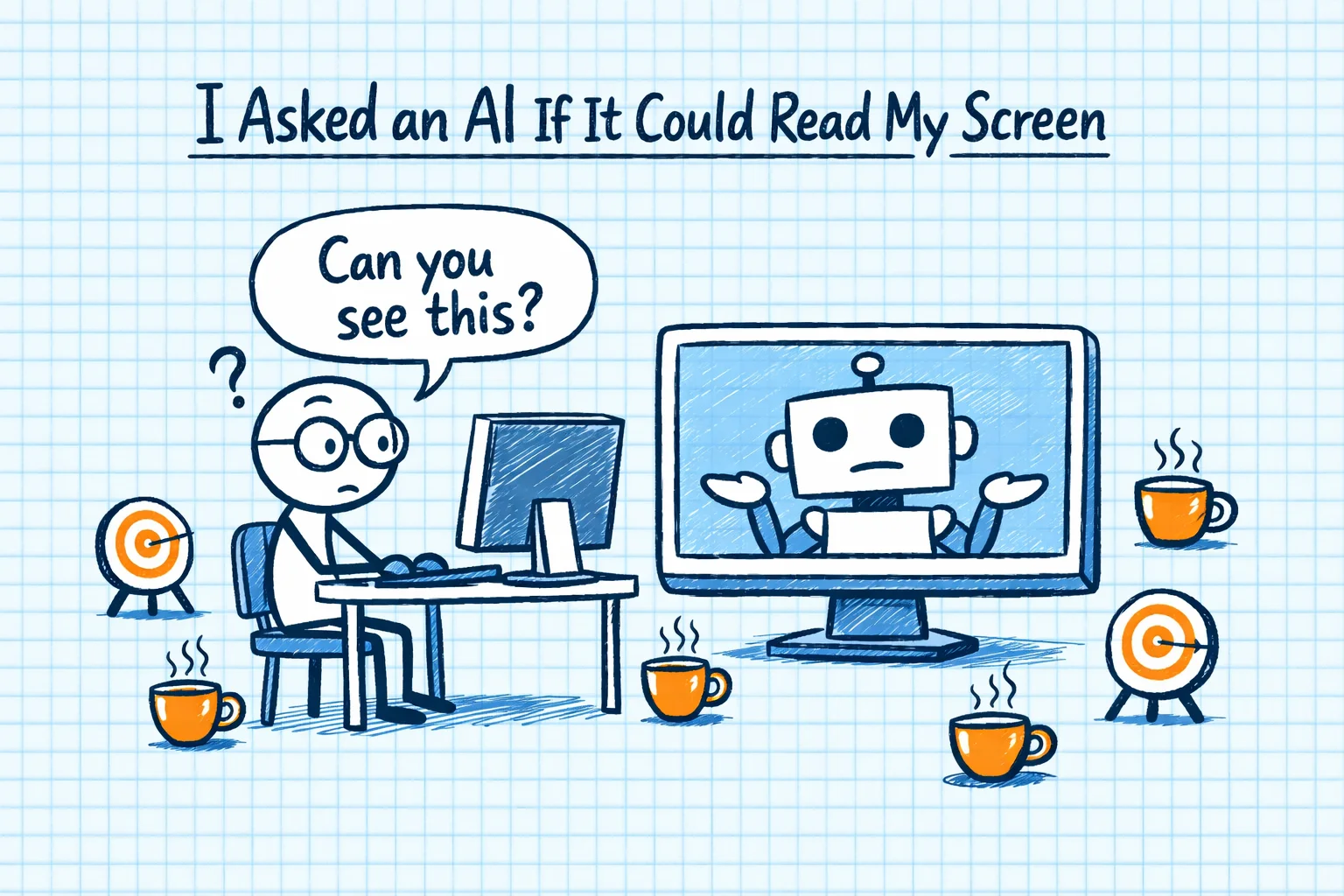
I'll be honest with you. My first few conversations with AI were not my finest hour.
I'm a .NET developer. I've been building software for over fifteen years. I've co-founded businesses, shipped products used by millions of people, and held the CTO title at a SaaS company serving millions of users. I'm not easily impressed by technology.
So when I finally opened Claude for the first time in August 2025, what did I do? I asked it if it could read my screen.
It could not.
Then I asked if it could make images. It could not do that either. I asked if it could search the internet. Nope. I asked whether my conversations were being used to train the model - a perfectly reasonable question, but the way I asked it probably betrayed exactly how little I understood about how any of this worked.
Within the same session, I was asking it about archery sights. Not software architecture. Not Azure deployments. Archery sights. Because apparently the first thing a CTO does when given access to one of the most powerful AI systems ever built is use it to research a Mybo Tenzone stabiliser.
The "What Does This Thing Even Do" Phase
Looking back, what strikes me is how completely I misunderstood what AI was for. I kept trying to map it onto tools I already knew. Can it integrate with Visual Studio? Sort of, but not in the way I was imagining. Can it see what's on my screen? No, it's a language model, not remote desktop software. Can it generate the images I need for a website? No, but it can tell you exactly what to ask Midjourney for.
I think most developers go through this phase, and I think it's worth being honest about it. The "my AI journey" posts you see online usually start with the author sounding like they immediately grasped the potential. They didn't. Nobody does. You fumble around, you ask stupid questions, and you gradually build a mental model of what this thing actually is.
For me, the mental model that clicked was this: it's like having a very knowledgeable colleague who's always available, never judges your questions, and occasionally gets things confidently wrong. That last bit turned out to be important.
The Moment It Started Clicking
I think the turning point was when I stopped treating it like a search engine and started treating it like a conversation. I had a genuinely tricky problem with an Azure DevOps pipeline for a WebJob deployment - the kind of thing where you've been staring at YAML for an hour and everything looks right but nothing works. I just... described the problem. In plain English. And it came back with a structured, thoughtful response that identified two things I hadn't considered.
Neither of them turned out to be the actual fix, as it happens. But the process of explaining the problem to something that could engage with the technical details - that was different from Googling. That was closer to pair programming. Rubber duck debugging, except the duck talks back and sometimes has genuinely good ideas.
Privacy and Trust
One thing I was right to ask about early was privacy. I'm a CTO. I work with sensitive business data, client information, financial models. Before I was going to paste any of that into a chat window, I needed to understand what happened to it. Are my conversations used to train the model? Where is the data stored? Who can see it?
The answers were reassuring enough that I gradually started bringing real work problems to the table. But I'm glad I asked. If you're a developer considering using AI for work, ask those questions first. Understand the data handling. Read the privacy policy - actually read it, not just click "accept". Your clients and your company deserve that diligence.
What I'd Tell Past Me
If I could go back to August 2025 and talk to the version of me who was asking about archery sights, I'd say three things:
First, stop trying to figure out what it can't do and start exploring what it can. You're a developer - you'll hit the limitations soon enough through actual use. Don't waste time cataloguing them upfront.
Second, talk to it like a colleague, not a search engine. Give it context. Explain what you're trying to achieve, not just what you want to know. The quality of the output is directly proportional to the quality of the input.
Third, you're about to fall down one of the most interesting rabbit holes of your career. Within six months you'll be running multiple AI agents in parallel, building MCP integrations into your products, and fundamentally rethinking how you write software. The archery questions were just the warm-up.
But I'm getting ahead of myself. That's for the next post.