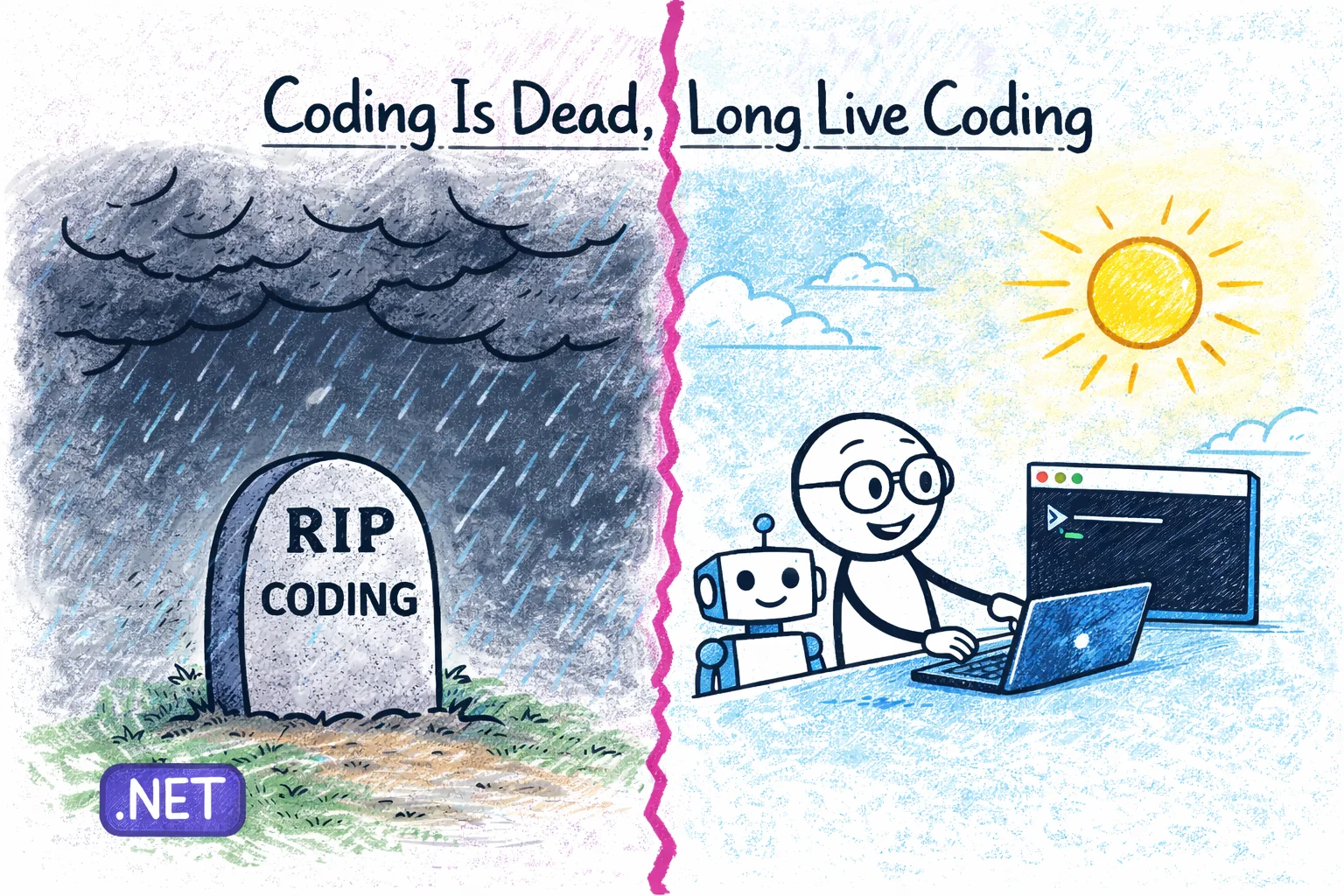
In November 2025, Anthropic launched Claude Opus 4.5 with a headline that rippled across every developer forum and tech news site on the internet: "Software engineering is solved."
Let that sit for a second. Solved. Not "improving" or "changing" or "being augmented by AI". Solved. As in finished. Done. Pack up your mechanical keyboards and go home.
This came a few months after Jensen Huang told the world that coding is no longer essential, and around the same time Zuckerberg was claiming AI would match mid-level engineers. The narrative was building: coding as a profession was over, AI had won, and anyone still learning to write software was wasting their time.
I read all of these takes. Then I opened Claude Code, asked it to help me debug a SignalR connection issue in a Blazor Server app, spent forty-five minutes going back and forth with it, and eventually fixed the problem using a combination of its suggestions and my own knowledge of the system.
Software engineering is "solved", apparently.
What They Mean vs What People Hear
To be fair to Anthropic, what they probably mean is something more nuanced: that AI can now handle a significant portion of the mechanical work involved in software engineering. Writing boilerplate code. Generating standard patterns. Producing first drafts of components that follow well-established conventions. And that's true. It absolutely can. I use it for exactly that, every day.
But what people hear is: "You don't need developers anymore."
And that's not just wrong - it's dangerously wrong. Because the gap between "AI can write code" and "AI can engineer software" is enormous, and conflating the two causes real harm. It scares parents into pulling kids out of coding classes. It makes junior developers question whether their career has a future. It gives executives the impression they can replace engineering teams with API subscriptions.
What AI Actually Does Well
Let me be specific, because I use AI for software development literally every working day. Here's what it's genuinely good at:
Pattern implementation. Need a CRUD endpoint? A repository pattern? A standard Blazor component with data binding? AI produces solid first drafts of well-established patterns faster than I can type them manually. This is real value.
Boilerplate and scaffolding. The tedious but necessary code that every project needs - configuration classes, dependency injection setup, model mappings. AI handles this well because it's formulaic work with clear conventions.
Research and synthesis. When I need to compare approaches, understand a new library, or evaluate technology options, AI compresses hours of documentation reading into minutes. It's an extraordinary research tool.
First-pass code review. AI catches obvious issues - null reference risks, missing error handling, inconsistent naming. It's not a replacement for a human reviewer, but it's a useful first filter.
What AI Can't Do (Yet)
Now here's the part the headlines leave out:
AI doesn't understand your business. When I'm building features for a large multi-tenant platform serving millions of users, the code isn't the hard part. The hard part is understanding the business rules - why this account type behaves differently from that one, why this edge case matters for compliance, why this seemingly simple change would break billing for a specific category of customer. AI doesn't know any of that. I do, because I've spent years learning the domain.
AI doesn't architect systems. It can implement architecture you've designed. It can suggest patterns. But the decision to use event-driven architecture versus request-response, to split a monolith into services, to choose eventual consistency over strong consistency - these are judgement calls that require understanding the full context of the system, the team, the business, and the trade-offs. AI gives you options. You make the decisions.
AI doesn't debug novel problems. When something breaks in a way that doesn't match known patterns - when the symptoms are misleading, when the root cause is a subtle interaction between three different systems, when the error message is lying to you - AI struggles. It pattern-matches against known problems. Novel bugs, by definition, don't match known patterns. These are the moments that separate experienced engineers from everyone else.
AI doesn't take responsibility. When that deployment goes wrong at 2am, when the billing system charges the wrong amount, when the data migration corrupts records - someone needs to understand the system deeply enough to diagnose and fix the problem under pressure. "The AI wrote it" is not a recovery strategy.
The Actual State of Play
Here's what I see from the inside, as someone who writes code with AI every single day:
Coding as "typing syntax into an editor" is declining. That part of the job is increasingly automated, and it should be. It was always the least interesting part. Nobody became a software engineer because they love typing semicolons.
Software engineering as "solving complex problems with technology" is thriving. If anything, AI has increased the demand for people who can think clearly about systems, because you can now build more ambitious things faster - which means you need people who can manage that ambition responsibly.
The developers who are struggling are the ones whose entire value was typing speed and syntax knowledge. The developers who are thriving are the ones who understand systems, business domains, and the messy reality of production software - and are using AI to amplify that understanding.
What "Solved" Actually Looks Like
If software engineering were truly solved, I'd describe a problem in plain English and receive a working, tested, production-ready system that handles edge cases, scales under load, integrates with existing infrastructure, meets compliance requirements, and doesn't break when a user does something unexpected.
That's not where we are. That's not close to where we are.
What we have is a very powerful tool that makes good engineers significantly more productive. That's genuinely transformative - I ship more, faster, with fewer bugs than I did before I started using AI. But it's a tool. It amplifies capability. It doesn't replace it.
Long Live Coding
Coding is dead in the same way that arithmetic is dead because calculators exist. The mechanical act has been automated. The thinking hasn't.
If you're a developer, your job isn't disappearing. It's changing. The mechanical parts are being automated, and the parts that require human judgement - architecture, debugging, business understanding, trade-off analysis, system design - are becoming more valuable, not less.
If you're learning to code, keep going. You're not learning to type syntax. You're learning to think systematically, solve problems creatively, and understand how technology works at a fundamental level. AI makes those skills more powerful, not less relevant.
If you're a headline writer at a tech publication, please stop telling people software engineering is "solved". It's not helping anyone, and you're going to feel silly about it in five years when there are more software engineers than ever, each building things that were previously impossible - because AI gave them superpowers, not a redundancy notice.
Coding is dead. Long live coding.